



Understanding how both the composition of adhesives and product thickness affect the properties and workability of glulam panels is essential in manufacturing. This knowledge is critically important for production engineers, project managers, and technical buyers who aim to create high-quality wood materials.
Impact of Adhesive Additives on Glulam Properties
Inorganic Additives and Their Effects
Inorganic additives used in adhesives significantly influence the physical and chemical properties of glulam panels. TalTech studies have shown that the chemical bonds in adhesives largely determine product durability and workability [](https://digikogu.taltech.ee/et/Download/47a7625d-a968-4ea9-9dea-e4759f01f752).
Key inorganic additives include:
- Metal salts – increase the moisture resistance of glulam panels but may make finishing more difficult
- Silicon dioxide – improves adhesive bond strength but can accelerate the wear of processing equipment
- Lime compounds – neutralize acidic compounds but may affect color tone
In practical applications, it’s important to consider that adhesives with inorganic additives often require different processing parameters. For example, glulam panels made with adhesives containing high silicon dioxide content should be milled at lower speeds to avoid excessive tool wear.
Chemical Additives and Their Effects
Chemical additives in adhesives significantly impact glulam panel properties. Chemical bonds between adhesive and wood are crucial for strong adhesive joints. Covalent bonds provide the best protection against moisture, while ionic bonds may weaken in humid environments, as revealed by TalTech studies [](https://digikogu.taltech.ee/et/Download/47a7625d-a968-4ea9-9dea-e4759f01f752).
Main chemical additives and their effects:
- Moisture-resistance enhancers – reduce water absorption into the wood structure, extending product life in humid environments
- Fungicidal additives – protect against mold and fungi, particularly important for products used in humid environments
- Hardeners and catalysts – affect bond strength and drying time, allowing optimization of the production process
Impact of Glulam Panel Thickness on Product Properties
The thickness of glulam panels (especially in the 15-50 mm range) significantly affects product behavior in various conditions and applications.
Structure and Strength
The thickness of glulam panels directly affects their structural strength. Thinner panels are lighter and more flexible, while thicker panels offer greater rigidity and load-bearing capacity.
- 15-20 mm thick panels work well in the furniture industry but need additional support for larger surfaces. They are ideal for door panels, light shelving, and decorative elements.
- 25-35 mm thick panels are versatile, offering a good balance between strength and weight. They are ideal for furniture frames, doors, and medium-duty shelving.
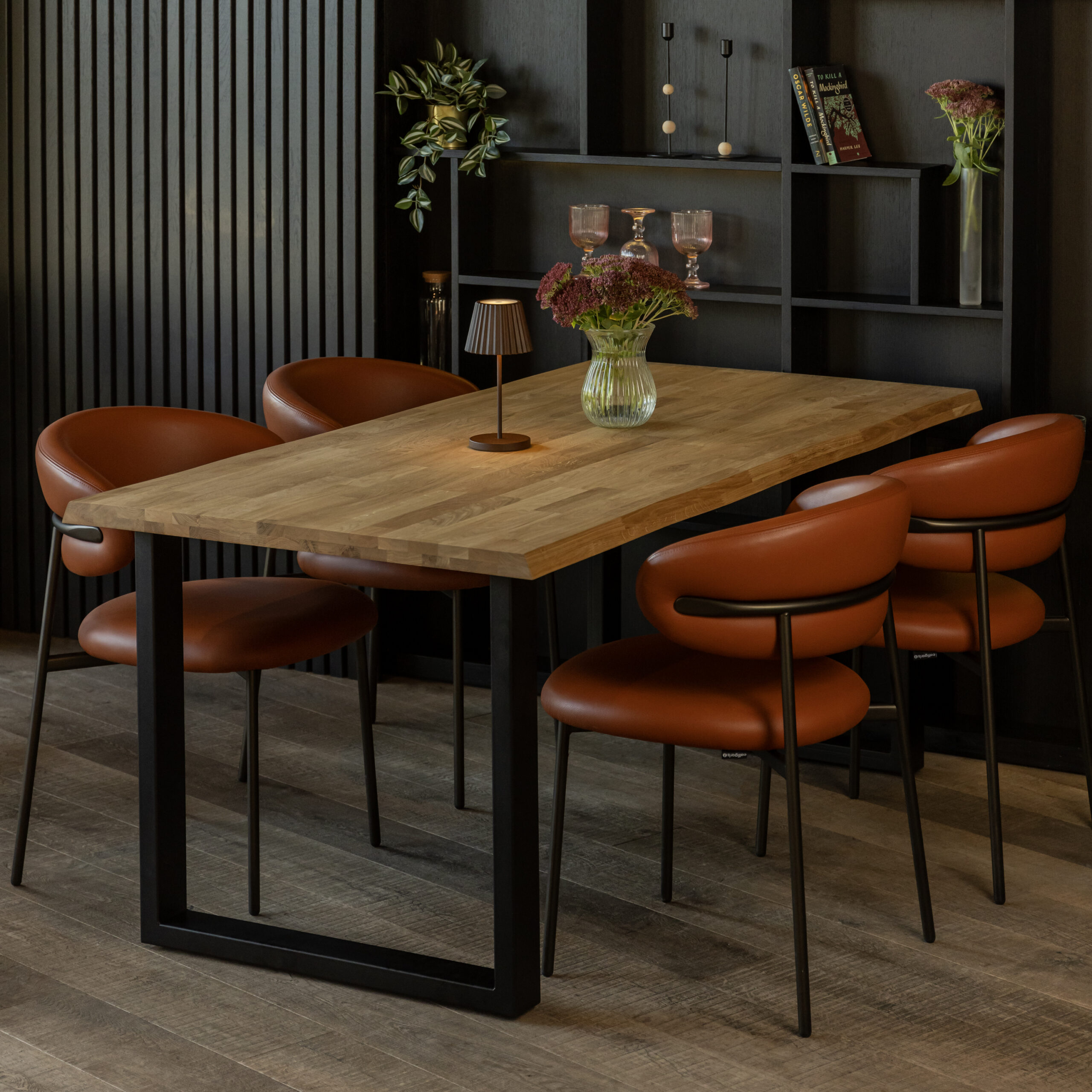
- 40-50 mm thick panels provide high load-bearing capacity and structural strength, suitable for work surfaces, tabletops, and flooring. Their stability and resistance to deformation are significantly better compared to thinner panels.
Durability and Moisture Resistance
The thickness of glulam panels significantly affects the rate and extent of moisture absorption. Thinner panels react more quickly to environmental changes, while thicker panels are more stable.
- Thinner panels (15-25 mm) react to moisture changes more quickly and may expand and contract more intensely, requiring more careful finishing and moisture barriers.
- Thicker panels (35-50 mm) are more stable in terms of moisture, but long-term moisture loading can cause internal stress and deformation. Their advantage is slower reaction to moisture fluctuations, making them more suitable for humid environments.
Wood density also significantly affects durability and moisture resistance, so dense wood structures should be chosen especially for humid environments.
Chemical Resistance
Glulam panel thickness also affects chemical resistance:
- Thicker panels (40-50 mm) are generally more chemical-resistant, as chemicals have a harder time penetrating deeper into the wood structure. This makes them suitable for kitchen surfaces, laboratories, and industrial environments.
- Thinner panels (15-25 mm) often need additional protection against chemicals with special varnish or oil coatings, especially when used in environments where chemicals or strong cleaning agents may be present.
Workability According to Thickness
Sanding
Sanding glulam panels of different thicknesses requires different approaches to achieve the best results without damaging the material.
- 15-20 mm panels require a cautious approach to sanding. It’s advisable to use lighter sanding tools and lower pressure, as there’s a risk of sanding through or creating surface irregularities. Too aggressive sanding can cause panel warping.
- 25-35 mm panels allow the use of medium-weight sanders and more stable processing. These offer a good balance between processing speed and safety.
- 40-50 mm panels can also withstand stronger pressure and heavier professional sanders, allowing more efficient processing without significant risk of deformation.
Cutting and Milling
According to GRECON ProfiJoint finger-jointing line technical data, tools with diameters of 160-250 mm are used for processing materials 15-50 mm thick, with an infeed length of 700 mm and outfeed length of up to 6000 mm [](https://www.drevari.sk/i1860/cinkovacka/buk?language=ee).
The impact of thickness on milling and cutting is significant:
- Thinner panels (15-20 mm) allow faster processing and lower energy consumption, but there’s an increased risk of material damage. When milling, it’s important to use the right feed rates and cutting edges to avoid edge splintering.
- Medium panels (25-35 mm) offer a good balance between working speed and stability, making them optimal for industrial production. They allow the use of a wider range of milling profiles and cutting techniques.
- Thicker panels (40-50 mm) require more powerful equipment, slower processing speeds, and higher energy consumption. However, they offer more stable results and allow more complex profile cuts without the risk of material damage.
Industrial Production Recommendations and Quality Control
Optimal Production Parameters
When producing glulam panels in the 15-50 mm thickness class, it’s important to monitor the following parameters to achieve the best results:
- Gluing conditions:
- Temperature: 18-22°C is optimal for gluing to ensure even drying and maximum strength
- Air humidity: 40-60% ensures wood stability and proper adhesion
- Gluing pressure: depending on wood density 0.6-1.2 MPa, with higher pressure applied to higher density wood species (oak)
- Drying time: significantly depends on material thickness
- 15-25 mm thick panels: 4-6 hours
- 25-35 mm thick panels: 6-10 hours
- 35-50 mm thick panels: 10-24 hours
Quality Control Measures
Several critical aspects should be monitored in glulam panel quality control:
- Moisture content: The optimal range is 8-12%, which should be measured with an electronic moisture meter. Too low moisture content can cause later expansion, while too high can cause shrinkage and deformations.
- Adhesive bond strength: Visual inspection and mechanical tests help identify weak spots. In a quality adhesive bond, the glue line should not be visible or should be minimally noticeable.
- Surface quality: A surface with even texture and color, free of defects, is a sign of a quality product. The surface should be smooth, without holes, cracks, or lamella separation.
- Dimensional accuracy: A tolerance of ±0.5 mm in thickness is the industry standard. Precise dimensions are especially important when connecting large panels and multiple boards.
Practical Risks and Mitigation
Several risks occur in glulam panel production that can be mitigated with proper methods:
| Risk | Mitigation Measure |
|---|---|
| Weak adhesive bond | Proper surface preparation, correct gluing pressure, and suitable adhesive type according to application |
| Deformations | Proper wood drying before processing, optimal moisture content (8-12%), and balanced lamella arrangement |
| Surface quality issues | Gradual sanding from coarser to finer abrasives, well-maintained tools, correct feed rates |
| Uneven color | Use of uniform quality wood batches, proper sorting, and wood origin traceability |
Recommended Adhesive Work and Finishing Solutions
15-20 mm Glulam Panels:
Thin glulam panels require special attention in both gluing and finishing:
- Use high-quality PVAc adhesives for rooms with low moisture loads or polyurethane (PUR) adhesives for conditions requiring better moisture resistance
- Thin-layer varnishes and oils that don’t add significant weight and allow the wood to “breathe” are suitable for finishing
- Avoid environments with high moisture loads, as thin panels have a greater risk of deformation
25-35 mm Glulam Panels:
This versatile thickness class offers a wide range of applications in different conditions:
- Suitable for most adhesive types, including PVAc, PUR, and EPI (emulsion polymer isocyanate)
- Oils, varnishes, and wax products are all suitable for finishing depending on the end use
- Offers a good balance between workability and durability, making it a popular choice among furniture manufacturers
40-50 mm Glulam Panels:
Thicker panels require special attention to adhesive selection and drying conditions:
- Reinforced adhesives for greater structural strength are recommended, especially melamine-urea-formaldehyde (MUF) or phenol-resorcinol-formaldehyde (PRF) adhesives for construction applications
- Hard varnishes and deep-penetrating oils that provide additional protection are suitable for finishing
- An exceptionally good choice for work surfaces and high-load surfaces where avoiding deformation is important
According to a master’s thesis on fire resistance of glued laminated timber, different adhesive types significantly affect material behavior in case of fire, with some adhesives maintaining strength at higher temperatures than others [](https://media.voog.com/0000/0009/4426/files/Jane_Liise_Nurk_Magistrit%C3%B6%C3%B6_Liimide_moju_inseneripuidust_konstruktsioonide_tulepusivusele_loplik_0.pdf).
Recommendations for Using Riverbank Products
Riverbank glulam panels in the 15-50 mm thickness class are designed to meet various requirements and applications. The advantages of our product range stem from high-quality raw materials and precise production processes.
15-20 mm panels are ideal for:
- Lightweight constructions where material weight is important
- Furniture elements such as door panels and drawer bottoms
- Decorative panels and interior design elements
25-35 mm panels offer universal solutions for:
- Furniture frames and cabinets
- Doors and partitions
- Shelving and display surfaces
40-50 mm panels are perfectly suited for:
- Work surfaces in kitchens and workshops
- Tabletops that need to withstand greater loads
- High-load constructions where rigidity and durability are important
Riverbank glulam panels are made from high-quality birch and oak wood, ensuring the best results in both the production process and end use. The quality of our products is confirmed by over 10 years of market experience and cooperation with demanding clients in Scandinavia, Western Europe, and the USA.
Next Steps
For more detailed information about Riverbank glulam products, visit our glulam products page. Our product range is flexible and diverse, allowing the production of glulam panels tailored to your needs.
Riverbank glulam products are available in the following dimensions:
- Length: maximum 4000 mm
- Width: maximum 1300 mm
- Thickness: 15-50 mm
For quotes and orders, contact us at +372 509 9151.
Your project’s success begins with choosing the right material – Riverbank’s quality glulam ensures lasting results and customer satisfaction.