



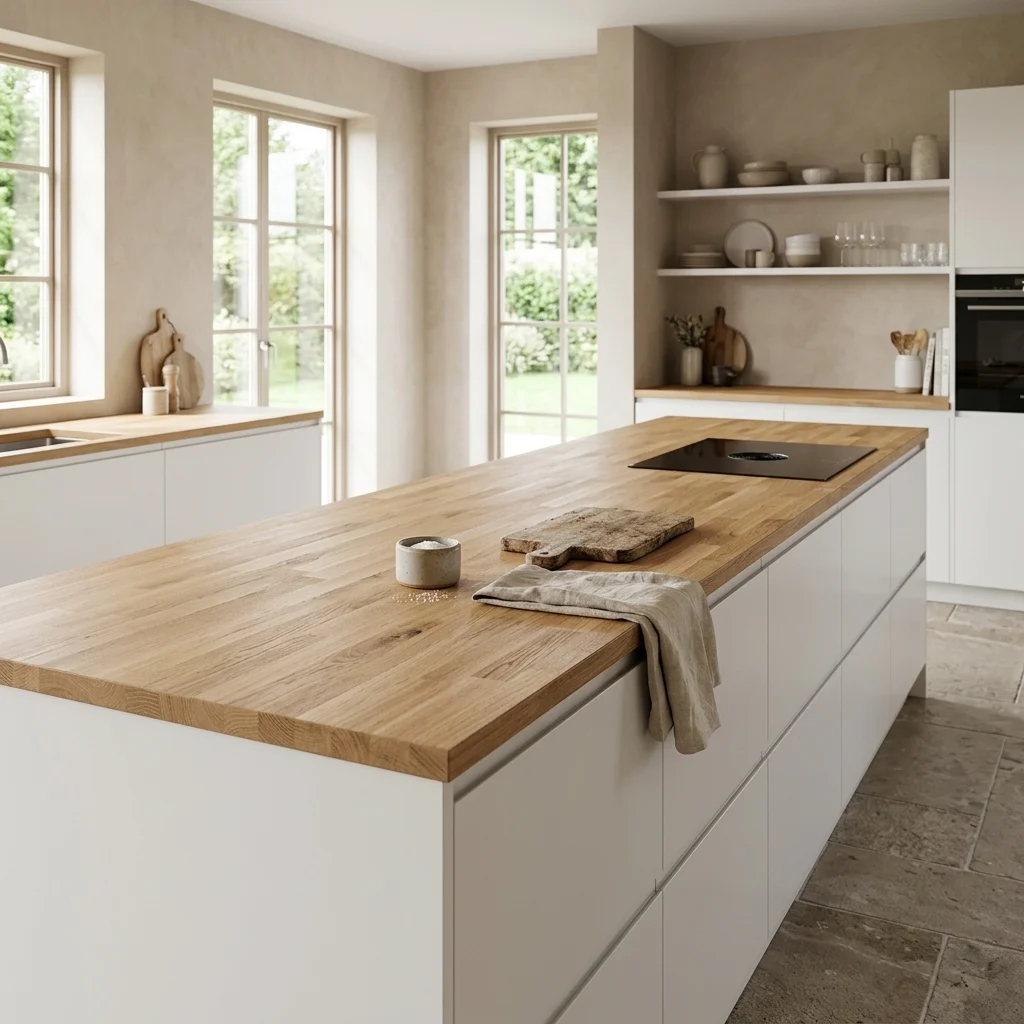
If you are looking for a kitchen worktop that can withstand heavy daily use while bringing natural warmth into your space, oak is an exceptional choice. Its high wood density and timeless aesthetic make it a durable, lasting surface. Riverbank OÜ manufactures precision-sized edge-glued wood panels tailored to meet the exact specifications of any kitchen project.
Oak Wood Strength and Durability in the Kitchen
Oak remains highly prized in kitchen design primarily for its mechanical durability. Rating at approximately 1,360 lbf on the Janka hardness scale, with an average density of 631.37 kg/m³, oak easily withstands rigorous daily use. Natural tannins within the wood also enhance its moisture resistance, significantly reducing the risk of rot compared to softer timber species.
When evaluated against alternative materials such as granite or quartz, a comparison of solid wood vs stone worktops highlights wood’s greatest advantage: restorability. While stone can chip or crack under heavy impact, surface wear and scratches on timber can be effortlessly repaired through sanding and re-oiling.
If you are weighing different timber options, a detailed durability comparison between oak and birch edge-glued wood offers valuable insight. Although birch is a lighter and more affordable alternative (see our guide on choosing a birch kitchen worktop), oak provides greater load capacity along with a richer, warmer tone. Before deciding on a material, review the general pros and cons of wooden worktops to ensure timber aligns with your daily kitchen demands.
Types and Quality Grades of Edge-Glued Wood
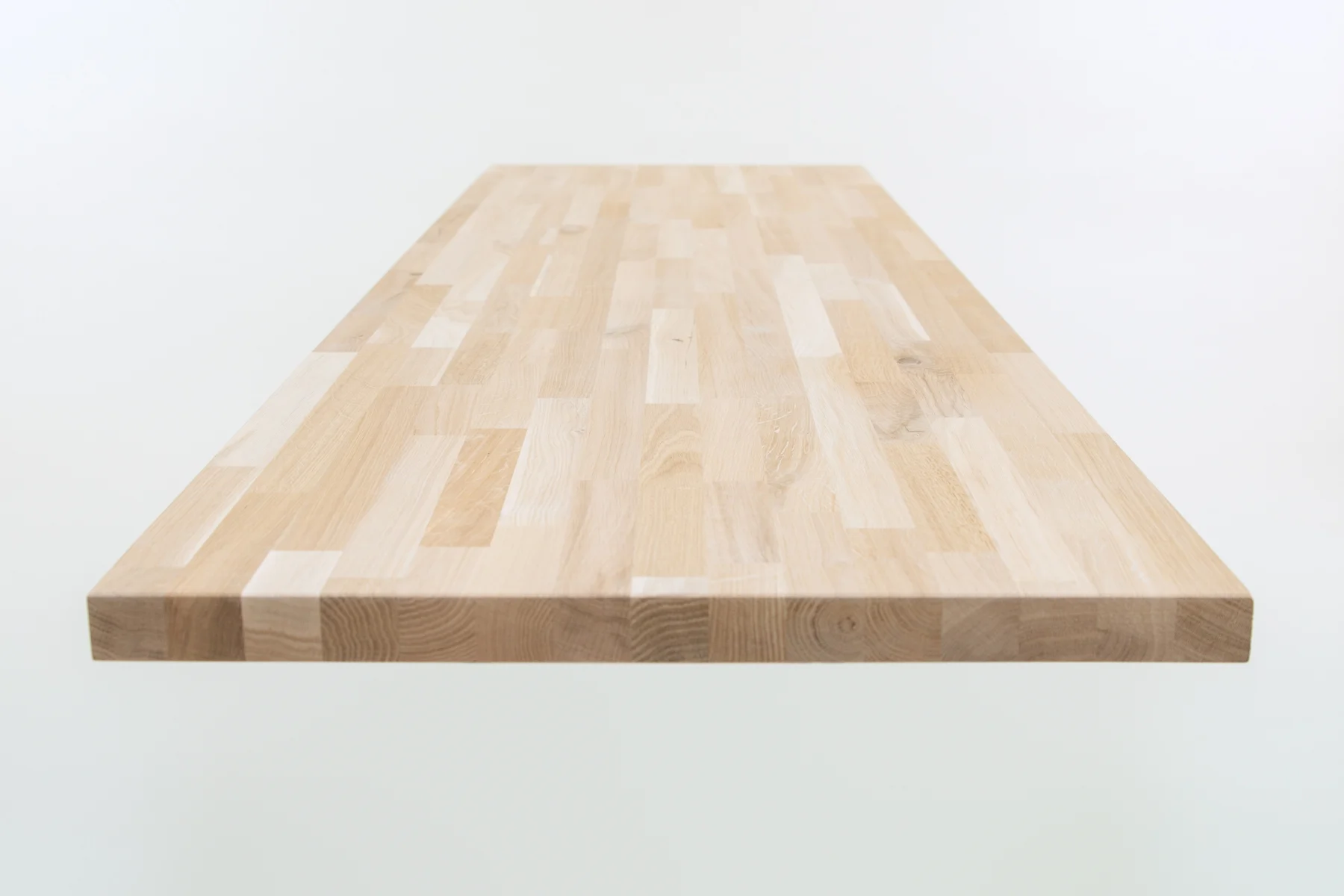
Because wood naturally expands and contracts in response to shifting temperature and humidity levels, wide surfaces are constructed using edge-gluing techniques. Staves are arranged specifically to minimize warping and prevent cracking over time.
Riverbank OÜ offers two main structural options:
- Full-stave panels – Continuous, full-length timber staves create a seamless, luxurious appearance alongside exceptional mechanical strength.
- Finger-jointed panels – Shorter timber blocks are joined end-to-end using interlocking finger joints. This technique enhances dimensional stability at a more accessible price point; learn more in our article on the advantages of finger-jointed timber over full staves.
Standard stave width is 40 mm, though custom 80 mm (deluxe) staves are also available upon request.
Production is categorized into two primary quality grades:
- AB Grade – The top face is clear of knots with a uniform color tone; the underside allows only occasional small knots.
- BC Grade – The top face permits small sound knots, while the underside allows unrestricted knots and natural color variations.
Dimensions, Thickness, and Kitchen Ergonomics
Our production facilities manufacture edge-glued panels up to 4,000 mm in length, up to 1,300 mm in width, and 15–50 mm in thickness. Standard kitchen cabinet setups frequently use widths of 600 mm, 635 mm, and 900 mm.
Selecting the right worktop thickness involves balancing visual proportions with structural deflection resistance:
- 15–20 mm thickness suits sleek, modern aesthetics but requires supplementary support from the cabinet subframe.
- 25–30 mm thickness serves as the industry standard, offering an ideal balance between weight and structural integrity.
- 38–50 mm thickness provides a classic, substantial feel suited for kitchen islands and heavy-use zones, maintaining long-term deflection under 2 mm per meter.
For further insight on practical considerations, see our guide on choosing worktop thickness.
When planning your kitchen layout, keep these key ergonomic recommendations in mind:
- Maintain a continuous work surface at least 90 cm wide and 60 cm deep next to the sink for primary food preparation.
- Allow landing space of at least 60 cm on one side of the sink and 45 cm on the other.
- Provide clear counter space of at least 30 cm on one side of the cooktop and 38 cm on the other.
- Ensure walkway widths are at least 91 cm, expanding to 107 cm for a single-cook zone and 122 cm for multi-cook kitchens.
Finishes: Oil vs. Lacquer
Protecting timber against moisture, food stains, and daily wear comes down to two main finishing methods:
Oiled Finish
An oiled wooden worktop accentuates the natural depth of the oak grain. The oil penetrates deep into the pores to repel water while preserving a warm, tactile matte texture. To finish, sand the surface with P220–P320 sandpaper, apply a food-safe wood oil, let it penetrate for 15–30 minutes, and wipe away all excess. Allow 12–24 hours of drying time between coats. A newly installed surface requires at least three initial coats of oil.
Lacquered Finish
A durable lacquered wooden worktop forms a protective film over the wood. Lacquer prevents liquid penetration and demands less routine maintenance than oiled surfaces. However, initial application requires careful surface preparation due to oak’s natural tannins, and refinishing is typically needed every 5–10 years.
Installation and Wood Movement
Solid timber is a living material that responds to changes in ambient humidity and temperature. Improper installation can lead to warping or splitting.
Essential installation guidelines:
- Acclimatization – Store the worktop in the installation room for at least 48 hours prior to fitting.
- Expansion gap – Leave a 3–5 mm gap between the back edge of the worktop and the wall to allow for wood expansion.
- Subframe – Ensure base cabinets are perfectly level and securely anchored.
- Fastening – Use slotted brackets or angle irons with oval holes that allow the timber to expand and contract freely without placing stress on screw connections.
- Cutouts for sinks and hobs – Measure cutouts accurately and seal exposed edges thoroughly before installing fixtures.
For a detailed step-by-step walkthrough, read our guide on wooden worktop installation.
Regular Maintenance and Long-Term Care
Following a proper maintenance routine ensures your oak worktop lasts for decades. Start by reading our general wooden worktop maintenance guide.
For advice tailored specifically to oak surfaces, refer to our guide on how to care for an oak worktop:
- The Water Drop Test – Sprinkle a few drops of water onto the surface. If the water beads up, the protective seal is working. If it absorbs and darkens the timber, it is time to re-oil.
- Re-oiling schedule – Frequently used oiled worktops should be refreshed with maintenance oil every 3–6 months. Pay extra attention during the first 6 weeks after installation.
- Daily cleaning – Wipe up spills immediately, especially around the sink area. Clean using warm water, a pH-neutral detergent, and a microfiber cloth. Avoid abrasive scrubbers, ammonia, or harsh acids.
- Heat protection – Never place hot pots or pans directly onto the wood; always use trivets or heat pads.
- Repairing minor damage – Light surface scratches can be sanded down with fine sandpaper (P220–P320) and re-oiled.
Oak Worktops for Your Kitchen from Riverbank OÜ
Riverbank OÜ brings over 10 years of woodworking expertise to every project. Our production lines are specifically calibrated to manufacture 15–50 mm thick solid wood panels custom-made to your exact dimensions. We use only certified, safe materials, combining modern machinery with skilled craftsmanship.
Whether your layout calls for full-stave luxury or finger-jointed stability, we can help you choose the ideal wood grade, edge profile, and finish. Contact us at +372 509 9151 for a personalized quote and lead time details.