



Why do solid oak tables crack during their first winter, even when built from premium timber? While edge-glued panels cannot stop wood from moving, they do make that movement predictable. This guide covers material selection, panel sizing, and joinery techniques to ensure your furniture lasts for decades.
Quick Guide: Matching Panels to Components
| Component | Recommended Panel | Thickness |
|---|---|---|
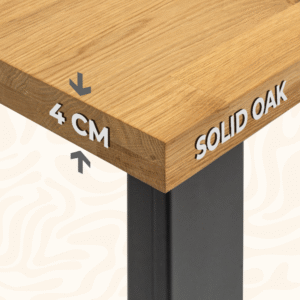
| Dining and coffee tabletops | Full stave, AB grade on visible face | 40–50 mm |
| Cabinet and shelving carcasses, door frames | Finger-jointed or full stave | 25–35 mm |
| Door panels, lightweight components | Finger-jointed, especially for painted finishes | 15–20 mm |
| Cabinet interiors, concealed components | Finger-jointed, BC grade | Sized to load |
These recommendations reflect Riverbank’s manufacturing standards, where panels between 15 mm and 50 mm form the backbone of our production. Below, we break down the engineering logic and exceptions behind these dimensions.
Solid Timber, Edge-Glued Panels, or Sheet Goods: Choosing the Right Material
Sawn lumber comes directly from the log as individual boards. An edge-glued panel, by comparison, is engineered by bonding solid wood staves edge-to-edge. Both are 100% natural wood; an edge-glued panel uses the exact same timber as raw planks, but rearranges narrower staves into a wider, significantly more stable format.
The real advantage of edge-glued panels is not that the timber stops moving—no adhesive or joint can override natural seasonal expansion. Instead, edge-gluing delivers kiln-dried, wide-format panels with predictable stability and consistent surface grading right out of the crate. Riverbank manufactures panels up to 4,000 mm long, 1,300 mm wide, and 15–50 mm thick—dimensions virtually impossible to mill from single boards without severe cupping and checking.
Deciding between edge-glued wood and composite panels? Read our comparison of edge-glued timber and MDF in furniture making. To see how these panels are built from the log up, explore our guide to edge-glued panel and solid timber production.
European standards provide clear quality benchmarks here. Solid wood panels (SWP) fall under EN 13353, which defines their technical performance classes. Class SWP/1 NS specifies non-structural panels intended for dry, indoor environments—the standard for residential furniture. For hardwoods, surface appearance grades follow EN 13017-2. Note that Riverbank’s AB and BC designations are internal quality tiers developed to exceed these baseline European standards.
Finger-Jointed vs. Full Stave: Where to Use Each
Finger-jointed panels use shorter timber blocks interlocked end-to-end with precision finger joints before being glued along their edges. This technique maximizes yield, lowers costs, and yields longer panel lengths. Finger-jointed stock is an outstanding choice for painted components, structural internal framing, and concealed casework. For a deeper look, see our article on the practical advantages of finger-jointed timber.
Full stave panels run continuous, unbroken staves along their entire length. This produces a cohesive, elegant grain pattern, making full stave stock the premier option for dining tables, desk tops, and prominent show surfaces.
A simple workshop tip: inspect the panel under low-angle raking light. Finger joints stand out prominently under shallow illumination. If that staggered block pattern conflicts with your aesthetic vision, choose full stave panels.

Birch, Oak, or Pine: What the Data Shows
Riverbank produces edge-glued panels primarily in birch and oak, reserving pine for solid wood bed frames and utility components. Here is how these species compare at an industry-standard 12% moisture content (data sourced from The Wood Database):
| Species | Density | Janka Hardness | Characteristics |
|---|---|---|---|
| Pine | approx. 550 kg/m³ | 2,420 N | Soft, easy to machine, rustic character |
| Birch | approx. 640 kg/m³ | 5,360 N | Uniform, pale, fine-textured grain |
| Oak | approx. 675 kg/m³ | 4,980 N | Pronounced grain figure, dense, classic appearance |
Many makers are surprised to discover that birch actually outranks European oak on the Janka hardness scale. Oak’s reputation does not stem from raw surface hardness alone, but rather from its distinct cathedral grain figure and exceptional resistance to long-term wear. For clean, minimalist Scandinavian furniture, birch is hard to beat. If you want deep grain character and traditional presence, choose oak. Read our detailed durability comparison of oak and birch edge-glued panels to see which suits your project.
Pine is considerably softer than both hardwoods. While it works well for children’s bedroom furniture and light bookshelves, daily use as a dining surface will quickly leave dings and impressions. You can read more in our comparison of pine and birch for furniture.
Thickness and Sizing: Matching Panels to Purpose
- 15–20 mm: Best for drawer boxes, cabinet door panels, and lightweight framing. Because these panels are thin, sand them sparingly and rely on surrounding joinery for overall structural rigidity.
- 25–35 mm: Ideal for cabinet carcasses, heavy-duty shelving, and structural furniture frames.
- 40–50 mm: The standard for dining tables, heavy coffee tables, and kitchen countertops subject to substantial mechanical loads.
Riverbank panels are manufactured with a thickness tolerance of −0/+1 mm and a width tolerance of −0/+6 mm. This means a panel may arrive up to 6 mm wider than ordered. If your design requires exact tolerances, always perform your final cuts and trimmings in the workshop after the timber has fully acclimated.
Wood Movement: Why Solid Wood Furniture Is Never Static
Solid wood continually absorbs and sheds ambient moisture in response to relative humidity. This seasonal expansion and contraction occurs across the grain; movement along the grain is negligible. According to Swedish Wood, timber shrinks from fiber saturation (around 30% moisture content) down to an oven-dry state at the following rates:
| Species | Radial Shrinkage | Tangential Shrinkage |
|---|---|---|
| Pine | 4.0% | 7.7% |
| Birch | 6.7% | 10.4% |
| Oak | 4.0% | 7.8% |
Notice that birch moves considerably more than oak. Gluing birch and oak edge-to-edge across the same wide surface introduces internal shear stress, as both species shift at different rates.
For heated indoor environments, the target equilibrium moisture content (EMC) for furniture grade timber is 8%. Riverbank panels ship at 8% ±2%. Building furniture with lumber dried only to 12% moisture will cause joints to pull apart and tops to crack as soon as central heating dries out the home in winter. Research from Swedish Wood indicates that moisture levels in heated Nordic homes drop to 2–6% in midwinter, rising back to 7–12% in humid summer months.
Calculating Movement: A 900 mm Oak Tabletop
Swedish Wood calculates that oak shifts by an average of 0.26% across the grain for every 1% change in moisture content. If indoor moisture swings by 4 percentage points between summer and winter (for example, from 9% down to 5%):
900 mm × 0.26% × 4 = approx. 9.4 mm
Over a single year, that 900 mm tabletop can expand and contract by nearly a full centimeter. While this formula serves as a baseline estimate—local humidity, finish choice, and stave orientation all play a role—the engineering takeaway is absolute: if you screw a wide solid wood top directly and rigidly to an apron or base, the panel will eventually crack.
How to Fasten a Tabletop Properly
Always secure tabletops with fasteners that hold the panel flat while permitting cross-grain movement:
- Figure-eight desktop fasteners: These pivot freely in shallow mortises cut into the top edge of the apron.
- Z-clips and wooden buttons: These lock the top down while sliding freely along a groove routed into the inside face of the apron.
- Slotted screw holes: Elongate mounting holes in your brackets perpendicular to the grain, use broad washers, and avoid overtightening the screws.
- Fixed centerline mounting: Screw the tabletop down solidly only along its central axis, allowing it to expand and contract symmetrically toward both outer edges.
The most common mistake in amateur woodworking is driving screws straight up through an apron into a wide tabletop. Across a broad surface, rigid fastening guarantees seasonal splits.
Joinery Principles for Edge-Glued Panels
When joining wide solid wood panels, keep the grain running parallel. Gluing a wide panel cross-grain to another solid board will inevitably tear the joint or the wood apart as the pieces fight each other’s movement.
- Mortise and tenon: The gold standard for primary load-bearing joints, delivering exceptional mechanical strength without hardware.
- Dowel and pocket-screw combinations: A dependable approach for fast, rigid internal casework.
- Knockdown hardware and connector bolts: Essential for flat-pack pieces and large assemblies like bed frames, heavy shelving, and dismantleable dining tables.
- Biscuit joinery (Lamello): Reliable for panel alignment and corner reinforcement in low-stress assemblies.
Long horizontal spans, such as wide bookshelf tiers or free-standing dining tops, often require longitudinal aprons or under-mount steel stiffeners to prevent long-term deflection (creep).
Finishing: Sanding, Oil, and Lacquer
Begin sanding with P80–P120 grit abrasives, working progressively up to P180–P240. Always sand strictly with the grain, never across it, and vacuum away all fine dust before applying finishes. For detailed techniques, refer to our guide on machining and finishing oak and birch as well as our overview on sealing and finishing edge-glued wood.
- Hardwax and penetrating oils soak into the wood pores, accentuating the natural grain depth. Oiled surfaces are easy to spot-repair and refresh, making them ideal for high-traffic dining tables and kitchen worktops.
- Lacquers and polyurethanes form a hard, non-porous film over the surface. They offer superior liquid resistance for commercial installations, but spot repairs require stripping and refinishing the entire component.
- Waxes yield an authentic, low-luster sheen with modest moisture protection, best reserved for decorative side tables and display cabinets.
For a side-by-side assessment of durability and maintenance, consult our guide to choosing between oiled and lacquered dining tables. Always run test finishes on offcuts first, as oak and birch absorb pigments and oils differently. Riverbank recommends reapplying maintenance oil to kitchen countertops quarterly, and to dining tables two to three times per year. Always use trivets under hot cookware, and shield solid furniture from prolonged exposure to direct sunlight and heating vents.
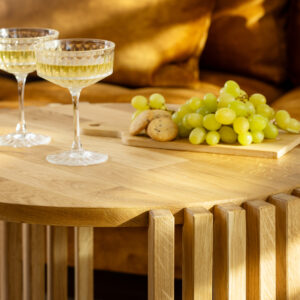
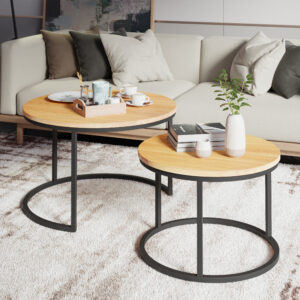
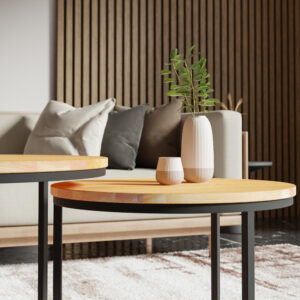
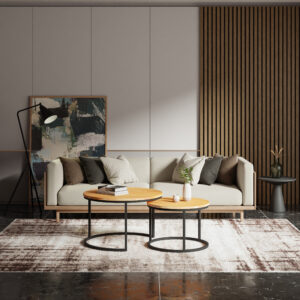
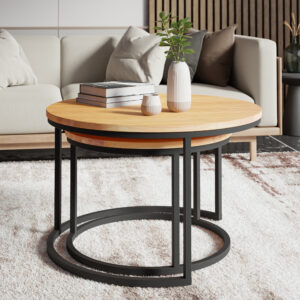
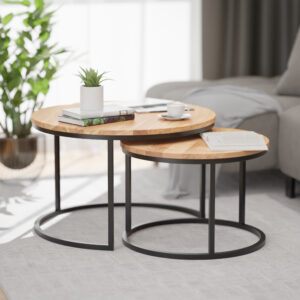
Here is how an oiled solid oak surface presents in a contemporary interior:

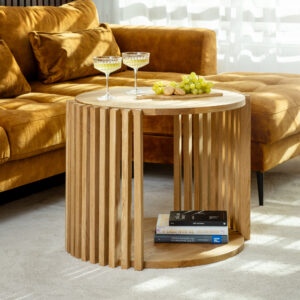
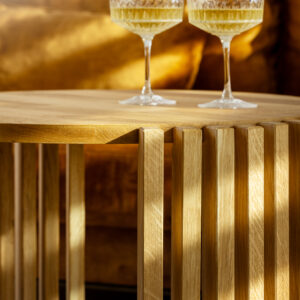
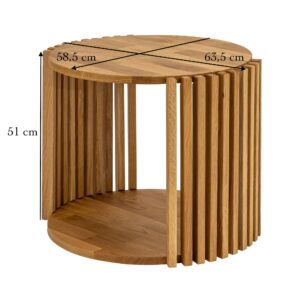
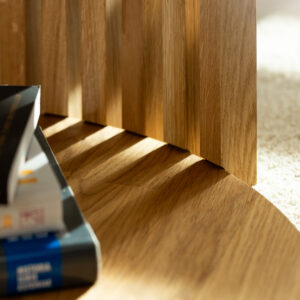
Discover more solid oak pieces in our coffee table collection and dining table collection.
Pairing Timber with Steel, Glass, and Upholstery
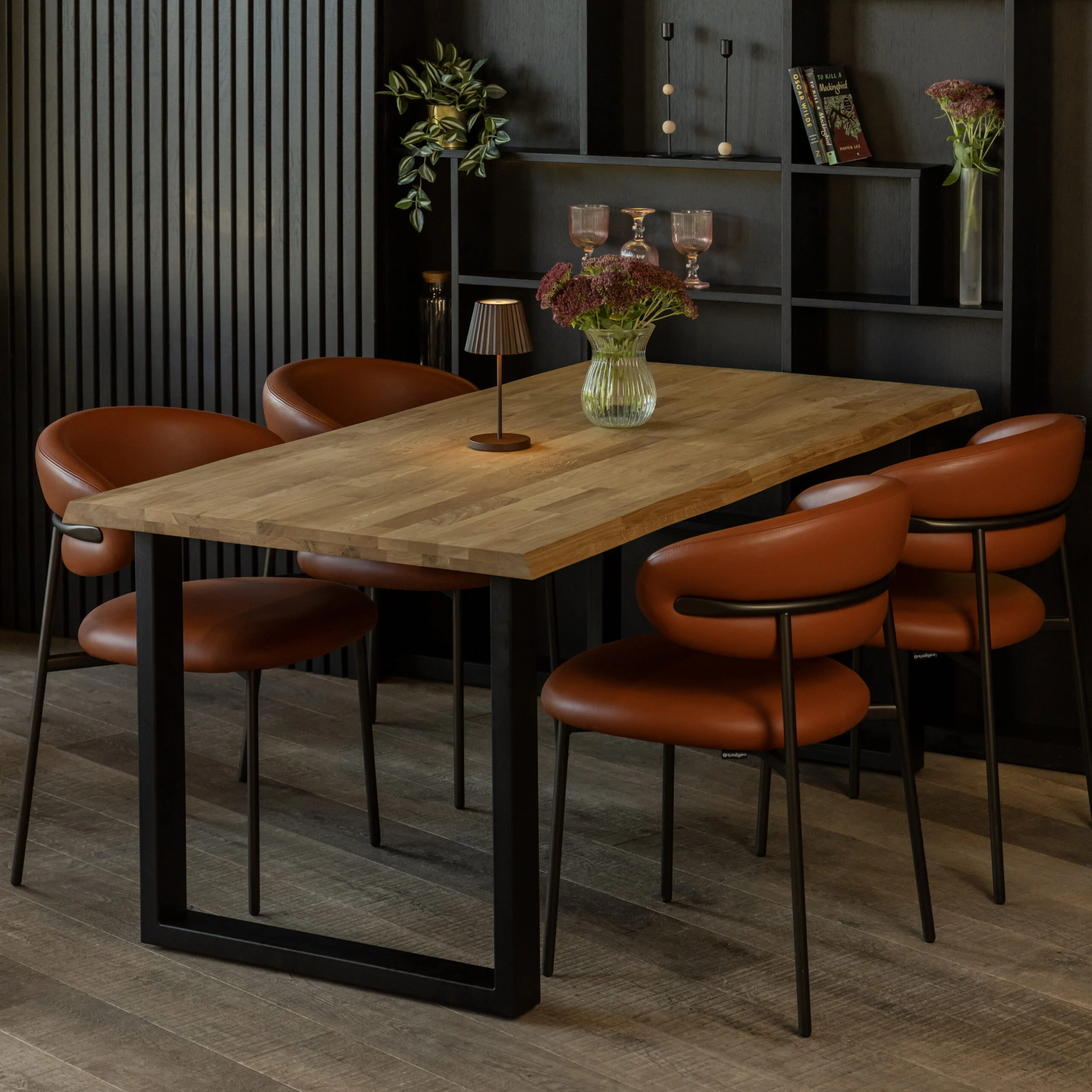
Steel: Marrying a thick timber top with a welded steel base is a hallmark of modern industrial design. However, while steel remains dimensionally inert, wood never stops breathing. Never fasten a wide timber slab directly through round holes in a steel flange. Mill elongated slots perpendicular to the wood grain, center your screws within the slots, and use broad flat washers so the fasteners can glide as the top breathes.
Glass: Avoid designing tight, captive rebates for glass panels. Accommodate wood movement by incorporating rubber or silicone isolation bumpers, and leave a generous expansion gap around the glass perimeter.
Leather and fabric: Upholstery is typically wrapped around narrow structural stretchers. Because seasonal movement is proportional to board width, narrow rails shift negligibly. Focus movement allowances on broad surfaces like bench seats and tabletops rather than chair frames.
Stone, HPL, and composites: Engineered sheet goods and natural stone share none of timber’s moisture-expansion characteristics. Always provide flexible slip joints wherever solid timber borders these materials.
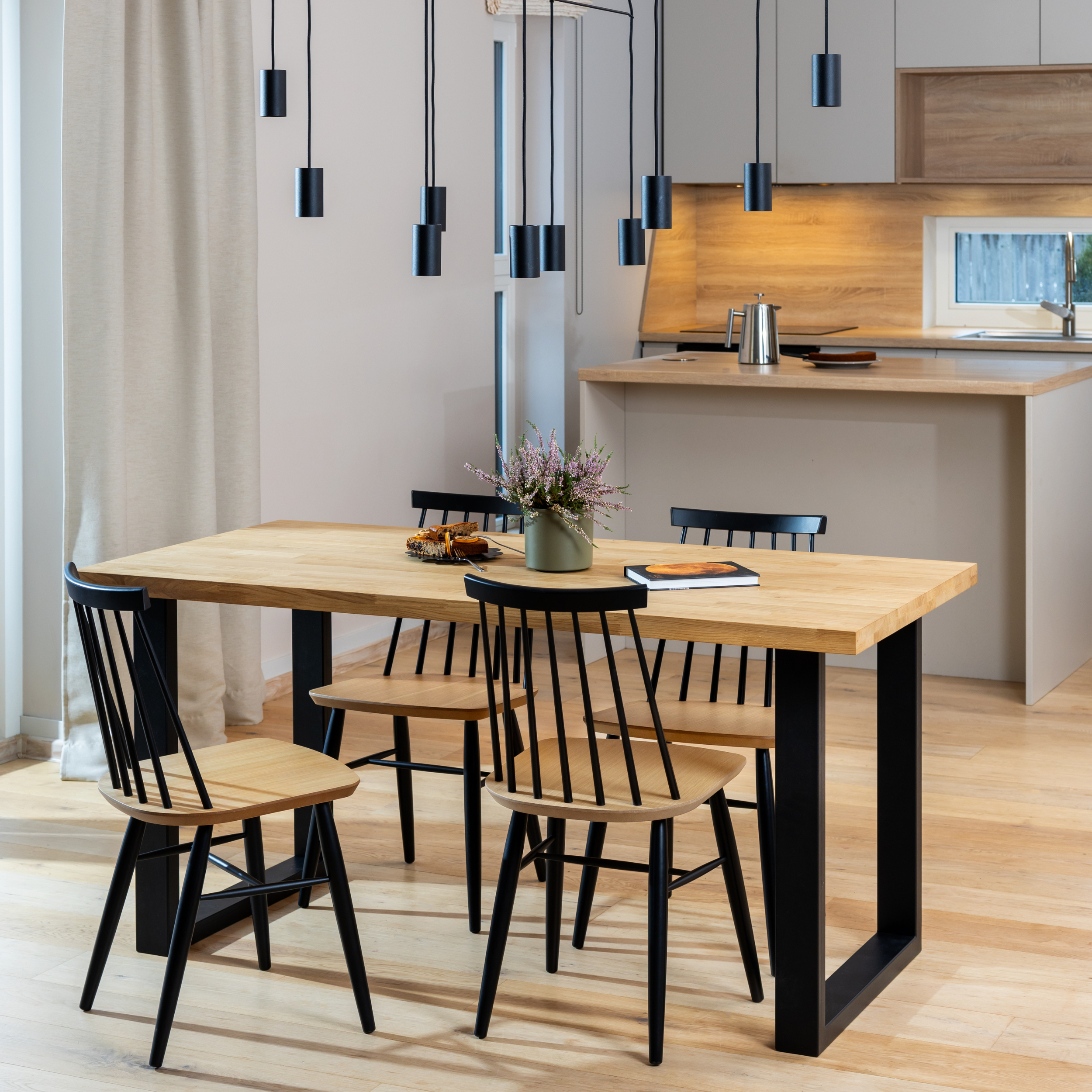
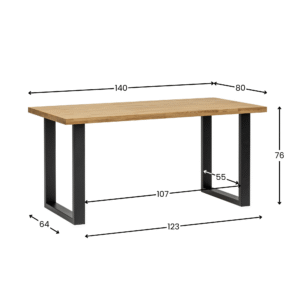
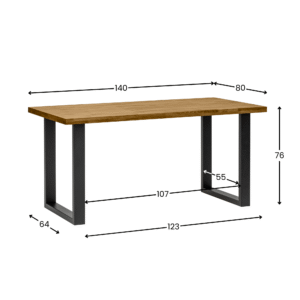
For finished examples of solid oak paired with welded steel bases, take a look at our LIIV dining table and Bliss coffee table.
-
-
-40%
Select options This product has multiple variants. The options may be chosen on the product page
- Dining Tables
Dining Table LIIV
- Price range: 372.60€ through 399.60€
-
-
-
-
-
-
-40%
Pre-Cut Checklist: Five Steps Before the First Cut
- Test moisture content: Check your panels with a calibrated pin meter and allow them to acclimate to your workshop environment before machining.
- Sort and face-mark: Designate premium AB faces for visible exterior surfaces, reserving BC faces for undersides and concealed framing.
- Detail movement joints: Double-check that all tabletop brackets, aprons, and cleats feature slotted holes or mechanical fasteners that permit cross-grain movement.
- Sample your finish: Sand and coat offcuts using your intended oil, stain, or clear coat to confirm tone and absorption.
- Verify grain flow: Confirm that adjacent panel edges share matching grain orientation before applying glue and clamping pressure.
Need custom panel sizing for your upcoming builds? Riverbank supplies precision edge-glued birch and oak panels milled to custom specifications. Send your cutting lists and drawings by email or contact us directly at +372 509 9151. For comprehensive technical specs before ordering, explore our edge-glued panel specifications and manufacturing quality criteria.